Ever find yourself tempted to skip your nightly skincare routine and fast-forward to dreamland? You’re not alone. A UK survey, as reported in the Daily Mail, found that a third of women go to sleep at least twice a week without cleansing their face, and 75 percent of readers in New Beauty admitted they’ve done this too. But sleeping in your makeup can lead to some not-so-pretty consequences for your skin, inside and out.
When a Daily Mail reporter decided to see what would happen if she abstained from cleansing her face at night over a 30-day period, her skin became extremely dry and sensitive, her eyelashes fell out in clumps and her pores grew by 5 percent. She also developed “eyelash dandruff.” The reporter noted that wrinkles on the sides of her face had grown worse, possibly due to her drying talc-based makeup.
Skipping your pre-bedtime face wash may not only cause you to look older, it could lead to problems that run more than skin deep. According to a study published in the Journal of Applied Toxicology in June 2015, heavy metals such as lead, mercury and cadmium found in cosmetic products may act directly on the skin or be absorbed through the skin into the blood, where they can accumulate in the body and exert toxic effects in various organs.
Why risk it? Help your skin stay healthy and get the most out of your ‘beauty rest’ by washing your face before you snooze. For best results, use a cleanser designed to address your unique skin concerns—wrinkles, acne, redness or discoloration. In a pinch, remove makeup with REDEFINE Eye Cloths, which deposit anti-aging peptides to reduce the appearance of wrinkles and puffiness.
Find out what the Doctors recommend for your skincare concerns
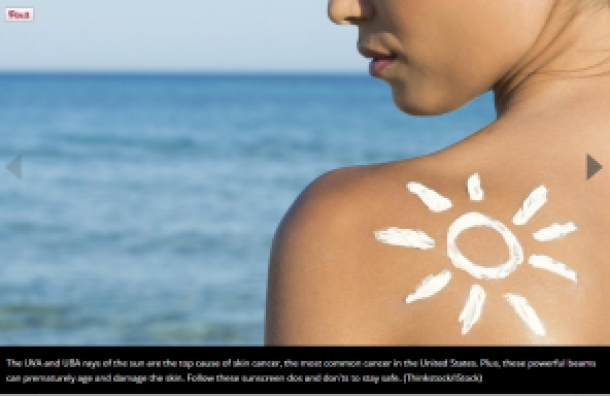
The UVA and UBA rays of the sun are the top cause of skin cancer, the most common cancer in the United States. Plus, these powerful beams can prematurely age and damage the skin. Follow these sunscreen dos and don’ts to stay safe. (Thinkstock/iStock)
Myth: Of course, everyone ages, but the way in which your skin ages is largely up to you. While dermatologic procedures can have a big impact, they can also entail significant expense, time spent in a doctor’s office and downtime after you leave.
Fortunately, you can also get consistent, long-term results from an at-home regimen without costly appointments or going under a knife or a needle.
If you are considering a fractal laser resurfacing treatment, for instance, you might try an at-home alternative, like REDEFINE AMP MD™ Micro-Exfoliating Roller, which offers firmer-looking skin with a noninvasive at-home tool.
If you are thinking about going to the derm office for a microdermabrasion treatment, you may consider REDEFINE MACRO Exfoliator™, a handheld microdermabrasion device for extreme smoothness and radiance.
Or, perhaps you’re thinking an injectable is your only option for smoothing wrinkles and expression lines, when, in fact, there are at-home, noninvasive alternatives, like ACUTE CARE™ Skincare for Expression Lines.
Inspired by dermatologists’ in-office treatments, these and other at-home products can help delay the signs of aging without the cost or pain of injectables and plastic surgery.
Technology is giving us lots of options without the risk of looking nipped and tucked.
Why not give us a try?
Free gift for new Preferred Customers (valid through Memorial Day)
A video of a Photoshopped 100-year-old woman went viral after this extreme “virtual makeover” illustrated the dramatic results of what if the woman were 70 years younger and wrinkle-free. The video, first posted in 2003 after a “Photoshop Surgeon” reverse-aged the woman using digital technology, trended again recently with over 6.5 million views and counting .
What will your face look like 20, 30, 40 years from now? Sun damage from early in life can show up years later as wrinkles, brown spots, unevenness and sagging skin. Stress, too, often manifests in the form of expression lines around your eyes and between the brows. Even heredity can play a role.
While no product can eliminate wrinkles as dramatically as the Photoshop experiment, you can take steps today to help stave off the signs of aging tomorrow.
1. Stress Less. By making small, incremental lifestyle changes, you can help mitigate your stress levels. Practice yoga 15 minutes a day. Take a walk after lunch. Get monthly massages. And when stressful instances occur, remember to b-r-e-a-t-h-e.
2. Wear Sunscreen Daily. UV exposure from the sun is responsible for 80% of your skin’s signs of aging. Fortunately, by applying a sunscreen like REDEFINE Triple Defense Treatment every day, you can help protect your skin against these harmful aging effects that often appear later in life.
3. Fill Expression Lines. Expression lines form over time as we smile, squint, frown or furrow our brows. ACUTE CARE™ Skincare for Expression Lines can help by filling expression lines with proprietary Liquid Cone Technology that melts line-defying peptides and hyaluronic acid directly into the wrinkle for smoother-looking skin.
You might not be able to wipe 20, 30 or 40 years worth of aging from your face with a click of a keyboard, but you can help create a more youthful-looking future with some lifestyle changes and a few choice skincare products.
Sun lovers continue to crowd the beaches every summer, despite widespread awareness of the risk of skin cancer. Now, a recent study published in the journal Cell may partially explain why.
According to the researchers, chronic exposure to UV radiation causes endorphins, or the body’s feel-good hormones, to release and set off a reaction like that triggered by certain drugs, leading to physical dependence, tolerance and addiction-like behavior in rodents.
“It’s surprising that we’re genetically programmed to become addicted to something as dangerous as UV radiation, which is probably the most common carcinogen in the world,” says senior study author David Fisher of Massachusetts General Hospital and Harvard Medical School. “We suspect that the explanation involves UV’s contribution to vitamin D synthesis in the skin. However, in the current time, there are much safer and more reliable sources of vitamin D.”
For some time, scientists have observed a link between sunlight and mood, as evidenced by Seasonal Affective Disorder (SAD), a form of depression related to changes in the season.
The connection between light and mood may also partially explain why indoor tanning is still in widespread use. Centers for Disease Control and Prevention researchers reviewed questionnaires from U.S. females ages 18-34 from 2010 and 2011, they found over 25% had used an indoor tanning bed at least once in the last year, while more than 15% had engaged in frequent tanning (10 times or more) over the same period.
Of course, the risks of UV exposure still far outweigh the benefits due to the incidence of skin cancer and the effects of photoaging.. For best results, avoid prolonged UV exposure, eat vitamin D-enriched foods like salmon, mushrooms, milk and cereal, and try a vitamin D supplement, such as ESSENTIALS Maximum D3 Vitamin D3®, as alternative healthy sources of vitamin D.

 Ever find yourself tempted to skip your nightly skincare routine and fast-forward to dreamland? You’re not alone. A UK survey, as reported in the Daily Mail, found that a third of women go to sleep at least twice a week without cleansing their face, and 75 percent of readers in New Beauty admitted they’ve done this too. But sleeping in your makeup can lead to some not-so-pretty consequences for your skin, inside and out.



 an at-home alternative, like


 Of course, the risks of UV exposure still far outweigh the benefits due to the incidence of skin cancer and the effects of photoaging.. For best results, avoid prolonged UV exposure, eat vitamin D-enriched foods like salmon, mushrooms, milk and cereal, and try a vitamin D supplement, such as ESSENTIALS Maximum D3 Vitamin D3®, as alternative healthy sources of vitamin D.
